
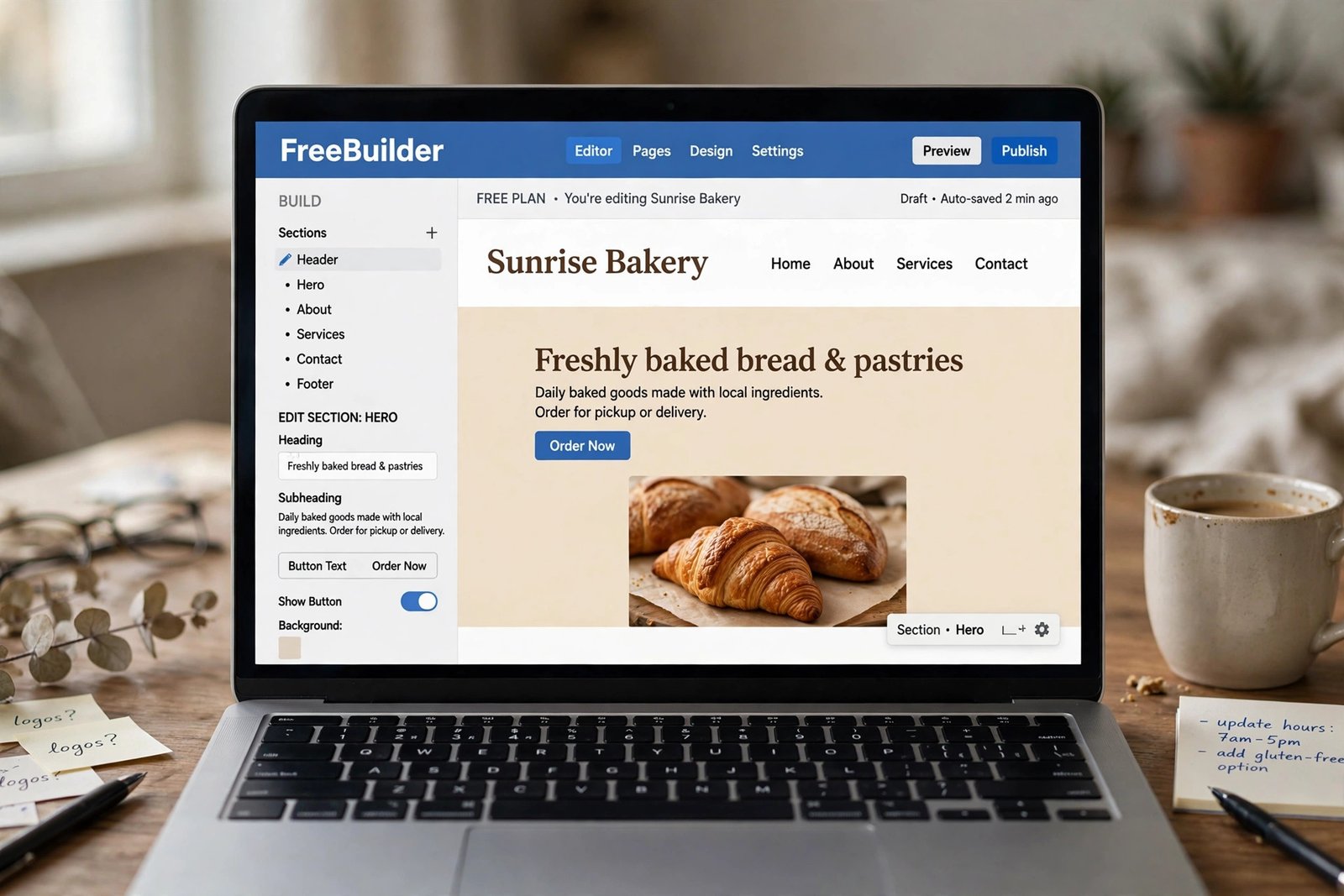
A free website sounds like an unbeatable deal: a professional-looking site, built in an afternoon, with nothing to pay. Millions of people have started that way, and for some of them it was exactly the right choice. But the word free, when applied to website builders, rarely means free in every sense. It usually means free at the point of entry, with limits that appear later — in the address of the site, in the branding on it, in the features you can use, and, most importantly, in how much of the site you actually own and control.
This guide explains what free website builders genuinely offer, what is limited or held back, when a free site is genuinely enough, when it starts to hold a business back, and the search and ownership pitfalls that catch people out. There are no prices and no named plans here, because the details change constantly and the principles matter more: once you understand how the free model works, you can judge any builder on its own terms, rather than taking its homepage at its word.
How the Free Website Model Works
Free website builders are businesses, and the free tier is their way of winning customers. The logic is straightforward. Building a website used to require technical skill, so a tool that lets anyone drag and drop a site together removes the biggest barrier. Offering that tool for free brings in a large number of users, some of whom will later need more than the free tier allows and will choose to pay for it, rather than start again somewhere else. That is a legitimate business model, and it explains almost every limitation you will meet: the free tier is designed to be good enough to start, and limited enough that growing businesses eventually outgrow it.
Understanding that logic changes how you read the offer. A free builder is not a charity, and it is not a trap either. It is a starting point with terms attached. The question is never simply whether a site is free. It is what exactly is free, what is restricted, what happens to your content if you leave, and whether those restrictions matter for what you want the site to do. A hobby site and a business that depends on search traffic will answer those questions very differently.
What Is Genuinely Free
The genuinely free part is usually substantial, and it is worth acknowledging fairly. Most free builders let you create a site without paying anything, choose from a range of templates, add pages, write text, upload images, and publish the result so anyone in the world can visit it. For someone who has never built a website, that is a real achievement in an afternoon: a live web presence, created without code and without hiring anyone. Hosting — the server space where the site lives — is typically included as well, which removes another technical hurdle and another bill.
Free tiers also tend to include the basics of getting found and getting contacted: a contact form, basic site settings, and some form of mobile-friendly layout, since so much browsing now happens on phones. For a simple purpose — telling people who you are, what you do, and how to reach you — that can be everything you need. Many community groups, hobby projects, and personal pages run happily on free tiers for years, because their needs never grow beyond those basics.

The free tier is also a genuinely useful way to learn. If you have never managed a website, building a free one teaches you how pages, menus, images, and forms fit together, without financial risk. You can test an idea, show a draft to friends or customers, and discover what you actually want from a website before committing to anything. Used that way — as a prototype or a learning exercise — a free site is hard to beat.
What Is Limited: The Usual Restrictions
The limits of a free site usually appear in a handful of familiar places. The first is the address. A free site typically lives at an address that includes the builder’s name, rather than a clean address of your own. That matters more than it first appears. An address that belongs partly to someone else looks less professional to visitors, is harder to remember and to print on business cards, and cannot travel with you if you ever move the site elsewhere. Every link, mention, and search ranking built on that address stays behind if you leave.
The second limit is branding. Free sites commonly display the builder’s branding somewhere on the page, sometimes discreetly and sometimes prominently. For a personal project that may not matter at all. For a business trying to look established and trustworthy, a badge advertising that the site was built for free can work against the impression you are trying to create, particularly when a potential customer is deciding whether to trust you with their money.
The third limit is features. Free tiers commonly restrict the things growing sites need most: the ability to sell online, to take bookings, to add advanced forms, to connect a custom email address, to access detailed visitor statistics, or to add extra functionality through extensions. Storage and bandwidth may also be limited, which matters once a site carries many images or starts attracting real traffic. None of these limits is hidden, exactly — they are usually listed on the builder’s own pages — but they are easy to miss when you are focused on getting a first site live.
The fourth limit, and the one people notice last, is control. Free tiers commonly offer limited control over the technical details of a site: how pages are structured, how quickly they load, how search engines are told about them, and how much of the underlying code can be changed. For a simple site, that control is unnecessary. For a site that must compete in search results or load quickly on a phone, it can become the deciding factor.
When a Free Site Is Enough
A free site is enough whenever the site’s job is modest and its audience is already known. A hobby blog, a portfolio for a student, a page for a local club or charity event, a holding page while a business prepares a proper site, or a test of a new idea before investing in it — all of these are well served by a free tier. In each case, the site does not need to rank highly in search, to process payments, or to project a polished corporate image. It needs to exist, to be accurate, and to be easy to share.
A free site is also a sensible choice when money is genuinely tight and the alternative is no site at all. A simple, honest, up-to-date free site beats no web presence, and it beats a social media profile alone, because it gives people a single place to find your details, your opening hours, or your contact form without needing an account on any platform. Starting free and upgrading later, when the business can justify it, is a rational path — provided you go in with your eyes open about what moving later will involve, which is covered below.
The test is simple: if the site’s limitations would not change any decision a visitor makes, the free tier is enough. If a visitor would think differently about you because of the address, the branding, or a missing feature, then the limitation is already costing you, even though no money has changed hands.
When a Free Site Holds a Business Back
The turning point usually arrives gradually. A business grows, and the site that was fine for announcing its existence now needs to win new customers, take orders, or compete with rivals who have invested in their own sites. At that point, the free tier’s limits stop being minor inconveniences and start shaping what the business can do. A shop that cannot sell properly online, a service business whose site looks amateur beside competitors, or a firm whose site cannot be found in search for the terms its customers actually use — each of these is a free site holding a business back, and each is easy to miss from inside, because the site still technically works.
Credibility is the first place this shows. Customers judge a business in seconds, and a site’s address, design, and polish are part of that judgement, fairly or not. A business asking customers to trust it with significant spending, sensitive information, or an ongoing relationship needs a site that looks like it belongs to a serious operation. A free-tier badge or an awkward address does not prove a business is unreliable, but it does nothing to reassure a cautious visitor either, and in a competitive market, reassurance is part of the sale.

Growth is the second place it shows. A business site needs to grow with the business: new services, new locations, new types of content, new ways for customers to get in touch or buy. Free tiers are built for a fixed shape of site, and stretching them beyond that shape often means awkward workarounds — pages that do not fit the template, features bolted on badly, or content squeezed into structures designed for something else. When every change becomes a workaround, the site is no longer serving the business. The business is serving the site.
The third place is competition. If your rivals have invested in proper sites with their own addresses, fast loading, clear structure, and full control over search, a free site is competing with a handicap. That does not mean a free site cannot ever rank or attract visitors. It means it is doing so while giving up several advantages, and the gap tends to widen as the rivals keep improving and the free site stays within its limits.
SEO Pitfalls of a Free Website
Search performance is where free sites most often disappoint, and the reasons are worth understanding before you build. Search engines can and do index free sites, so a free site is not invisible. But several factors work against it. An address that includes the builder’s name is weaker as a brand signal than an address of your own, and it splits authority: search engines see many sites sharing the same root address, and your site is one tenant among many rather than a property in its own right.
Control matters just as much. Effective search optimisation depends on details that free tiers often restrict: page titles and descriptions, heading structure, page speed, image handling, internal linking, and the technical signals that tell search engines how a site is organised. When those controls are limited or absent, you can still write good content, but you cannot present it as effectively as a competitor who controls every detail. Good content on a limited platform will usually lose to equally good content on a fully controlled one.
Migration is the pitfall that hurts most, because it arrives at the moment of success. A free site that starts to attract real search traffic builds its rankings on its free address. Moving to a proper address later means starting much of that search visibility again, unless redirects and migration are handled carefully — and free tiers do not always make redirects possible. Businesses that plan to grow should therefore think about migration before they build, not after they succeed. If a site is likely to matter for search in the future, starting on a foundation you own is usually cheaper in the long run than rebuilding visibility later. A technical review of the kind described in our guide to SEO audit services can show where a site is losing search visibility, and improving the pages that already perform, as covered in our guide to increasing a website’s page rank, is far easier on a site you fully control.
Ownership Pitfalls: Who Owns Your Website?
Ownership is the question most free-site owners never ask until it matters. With a free builder, you generally own your words and images, but you do not own the platform, the template, or the technical build of the site. That distinction becomes important the moment you want to leave. Many builders make it easy to build and hard to export: content may need to be copied page by page, designs cannot be taken with you, and features built into the platform simply do not exist elsewhere. The site you spent months building may be, in practical terms, impossible to move without rebuilding it.
Terms of service are the other half of ownership. A free account exists under terms the provider can change, and accounts can be suspended or closed for breaking those terms, sometimes with limited warning or appeal. For a hobby site, that is an inconvenience. For a business whose customers, enquiries, and reputation run through the site, it is a genuine risk. Paid accounts are not immune to terms either, but a business that pays for its own hosting and its own address has far more independence: it can move providers, keep backups, and control its own data.
Backups deserve a mention of their own. On a free tier, your backup strategy is whatever the provider offers, and you may have no easy way to download a complete copy of your site. Before building anything important on a free platform, check how you would get your content out. If the honest answer is that you would have to copy it manually, treat the site as temporary, however permanent it feels today. Keep your own copies of text and images elsewhere as a matter of habit, so that no platform decision can ever take your content with it.
How to Judge a Free Website Builder
Judging a builder well means looking past the homepage and asking a short list of practical questions. First, what address will the site have, and can you later connect an address of your own without rebuilding? Second, what branding will appear on the site, and where? Third, which features you are likely to need in the next year or two are restricted, and what would unlocking them involve? Fourth, how much control do you have over search settings, page speed, and site structure? And fifth, how would you export your content if you decided to leave?
Test the builder before committing your business to it. Build a trial page, view it on a phone, check how quickly it loads, and show it to someone who does not know it is free. Ask them what impression it gives, and whether they would trust it enough to enquire or buy. That outside view is worth more than any feature list, because visitors judge the result, not the tool that made it.
Also check how the builder handles traffic and measurement. A business site needs to know where visitors come from and what they do, and a free tier that hides that information leaves you guessing about what is working. Understanding your visitors, as explained in our guide to using a website traffic checker, is part of running any site well, and a builder that makes measurement difficult is making good decisions difficult too.

Finally, read the terms, at least the sections on content ownership, account closure, and what happens when a free account is inactive. Terms are dull reading, but they contain the answers to the questions that matter most when something goes wrong. A builder whose terms are clear and fair is a better bet than one whose terms are vague, however attractive its templates look.
Frequently Asked Questions
Is a free website really free?
The basic site usually is, in the sense that no payment is required to create and publish it. The limits — the address, the branding, restricted features, and limited control — are the real cost, and whether they matter depends on what the site needs to do.
Can a free website rank in search engines?
Yes, free sites can be indexed and can rank, particularly for less competitive topics or for a business name itself. But they compete with a handicap in address authority and technical control, so ranking for competitive terms is harder than on a site you fully own and control.
Can I move a free website to my own address later?
Sometimes, but not always cleanly. Some builders allow you to connect your own address to the same site, while others require rebuilding or leave you without proper redirects, which can cost search visibility. Check the export and migration options before you build, not after you succeed.
When should I stop using a free site?
When the site’s job outgrows the free tier: when credibility, selling, booking, search competition, or growth needs features the free tier restricts, or when the address and branding start shaping how customers judge you. That is the point at which a proper site stops being a cost and starts being an investment.
Conclusion
A free website is a genuine opportunity, not a trick — but it is an opportunity with edges. It gives anyone a live web presence in an afternoon, it teaches the basics of running a site, and it serves modest purposes perfectly well. It holds a business back when credibility, search competition, selling, or growth demand more than the free tier allows, and its deepest costs are not money but ownership and control: an address you do not own, a design you cannot take with you, and search visibility built on rented ground. Judge any free builder by its address, its branding, its restrictions, its search controls, and its export options, and choose free with a clear plan for what happens when you outgrow it. The best free site is one built knowingly, with its limits understood from the start.


