Every business has competitors, but in search the competitors that matter are not always the ones you think. The shop across the street may barely rank, while a blog you have never heard of quietly takes the top spot for your most valuable keywords. A proper competitive analysis finds out who is really winning your search traffic, what they are doing differently, and which of their advantages you can realistically close.
Done well, competitive analysis stops being spying and starts being strategy. It tells you which keywords are worth fighting for, which content gaps are costing you visitors, and where a small effort could outrank a much bigger rival. This guide walks through a practical competitor analysis for SEO, step by step, so you can run one for your own site without expensive tools or guesswork.
What Is a Competitive Analysis?
A competitive analysis is a structured comparison of your website against the sites that rank for the same searches you want to win. For SEO it covers four things: how much traffic competitors get and where it comes from, which keywords they rank for that you do not, what content earns them that traffic, and who links to them. The point is not to copy them. It is to find the gaps between their performance and yours, and to understand which gaps are worth closing first.
Keep the scope honest. A full analysis of ten competitors across every metric is a month of work nobody needs. Pick three to five true rivals, compare them on the metrics that drive rankings, and end with a short list of actions. An analysis that ends in a spreadsheet nobody opens has failed, however thorough it was.
Step 1: Identify Your Real Search Competitors
Start by listing the businesses you compete with directly, then check whether they actually rank for your target keywords. Often half of them do not, and the real competition is different: comparison sites, directories, publishers and aggregators that dominate the results pages you want to appear on. Search your ten most important keywords and note which domains appear again and again. Those are your search competitors, and they deserve the most attention.
Separate the list into two groups. Direct competitors sell what you sell and are worth studying for positioning and offers. Search competitors rank where you want to rank and are worth studying for content, keywords and links, even if they never sell a thing. Your strategy will differ for each group, but both belong in the analysis.
Step 2: Benchmark Their Traffic
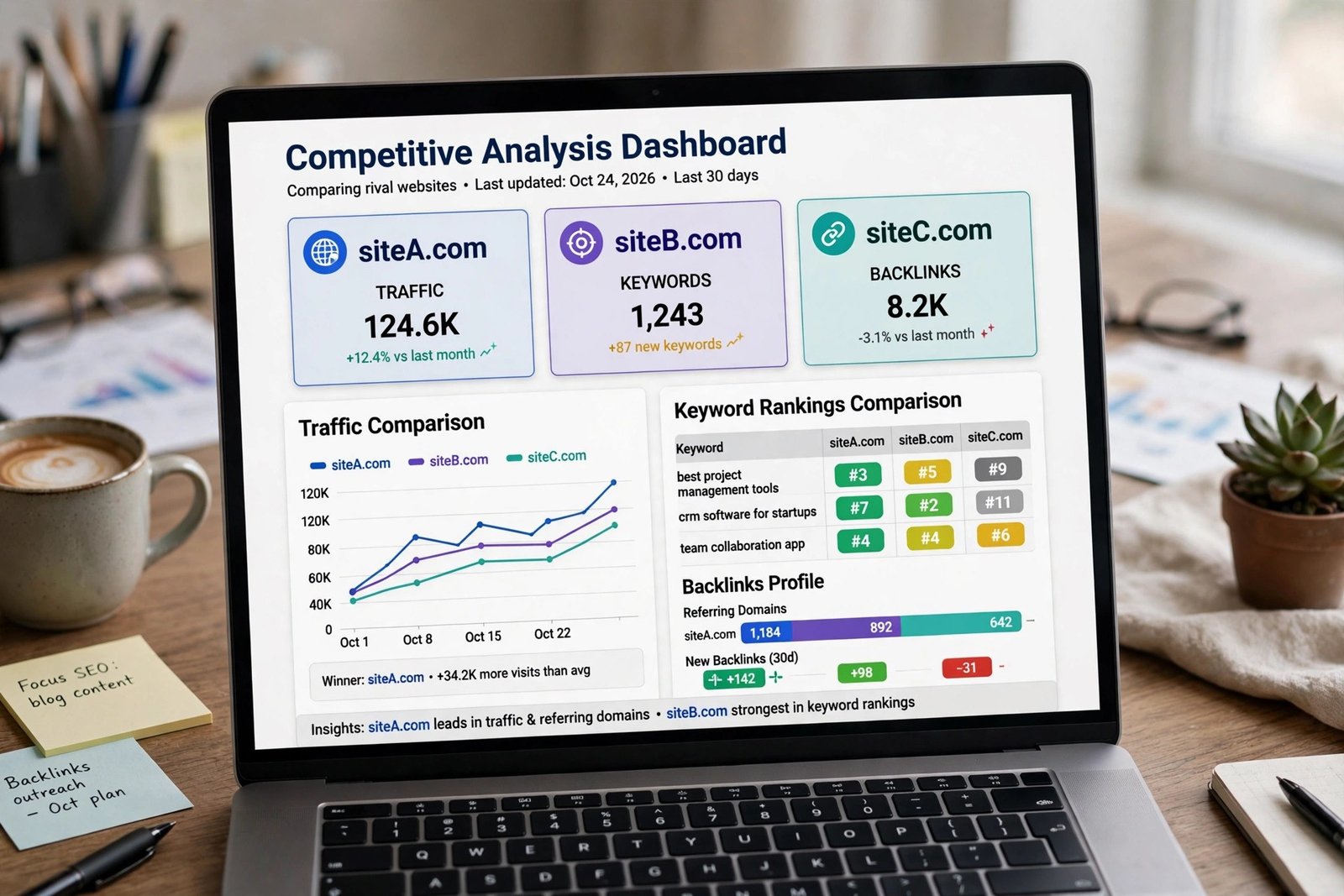
Traffic benchmarking answers the simplest question first: how big is each competitor, and is it growing? Use a traffic checker to estimate monthly visits, the trend over the last twelve months, and the split between organic search, direct, referral and social traffic. A rival with steady, search-led growth is a different threat from one whose traffic comes from a single viral page or a paid campaign that could stop tomorrow.
As with any estimate, treat the numbers as ranges, not facts, and compare tools before trusting a figure — our guide to using a website traffic checker explains why different tools disagree and how to read them sensibly. What matters most here is the shape of the picture: who is growing, who is flat, who is falling, and which channels drive each one. A competitor losing organic traffic may be beatable sooner than its size suggests, while a smaller rival growing fast deserves watching before it becomes the bigger problem.

Step 3: Find the Keyword Gaps
Keyword gap analysis is usually where the quickest wins hide. Export the keywords each competitor ranks for, filter to the ones relevant to your business, and split them into three buckets: keywords you both rank for, keywords they rank for and you do not, and keywords you rank for and they do not. The middle bucket is your opportunity list.
Prioritise that list by intent and realism, not volume alone. A keyword with modest volume and clear buying intent beats a huge informational term you cannot serve well. Also check position: a competitor ranking tenth for a term is vulnerable in a way that a competitor ranking first is not. Target the terms where you are one good page away from overtaking them, and leave the terms dominated by entrenched leaders until you have the authority to challenge them.
Step 4: Study Their Best Content
Next, look at which pages earn each competitor its traffic. In most cases a small number of pages do most of the work: a handful of guides, tools, comparison pages or category pages. Read those pages properly. What questions do they answer that yours do not? How deep do they go? What format do they use — long guide, calculator, template, video — and what would a genuinely better version look like?
This is where content gaps become editorial plans. If three competitors all draw steady traffic from beginner guides on a topic you have never covered, that topic belongs on your calendar. If their best page is thin and outdated, a stronger, current version is a realistic way to take its place. And if a competitor’s traffic depends on one page, that concentration is a weakness you can exploit by covering the topic more thoroughly across several pages.
Step 5: Compare Backlink Profiles
Links are still one of the strongest ranking signals, and backlink comparison shows you where a competitor’s authority comes from. Look at the number of referring domains rather than raw link counts, the quality and relevance of those domains, and the pages on the competitor’s site that attract the most links. A rival with links from respected industry publications is harder to displace than one with the same number of links from directories and forums.
Pay attention to linkable assets: the tools, original research, data studies and definitive guides that earn links naturally. If competitors keep earning links to a free tool or an annual industry report, building your own equivalent may do more for your rankings than months of outreach. Also note which of their links you could plausibly earn too — the same directories, resource pages and journalist requests are often open to you as well.

Step 6: Benchmark On-Page and Technical Basics
Finally, check the fundamentals. How fast are competitor pages compared with yours, especially on mobile? Do their key pages have clear titles, descriptive meta descriptions and sensible heading structure? How strong is their internal linking — do their most-linked pages pass authority to the pages that convert? A competitor can have great content and still be beatable if its site is slow, its category pages are thin, or its best pages sit five clicks from the homepage.
This step pairs naturally with improving your own pages that already rank, as covered in our guide to increasing a website’s page rank. Often the fastest competitive win is not a new article at all, but fixing the titles, internal links and page speed of pages you already have, so they can hold their own against better-optimised rivals.
Turn Findings Into an Action Plan
An analysis without actions is just reading. Boil everything down to a short, prioritised list: three keyword gaps to target with new pages, three existing pages to improve, three link opportunities to pursue, and any technical fix that blocks more than one of them. Assign each action an owner and a deadline, and set a date to re-run the comparison in three months. Rankings move slowly, but the direction of travel after a quarter tells you whether the plan is working.
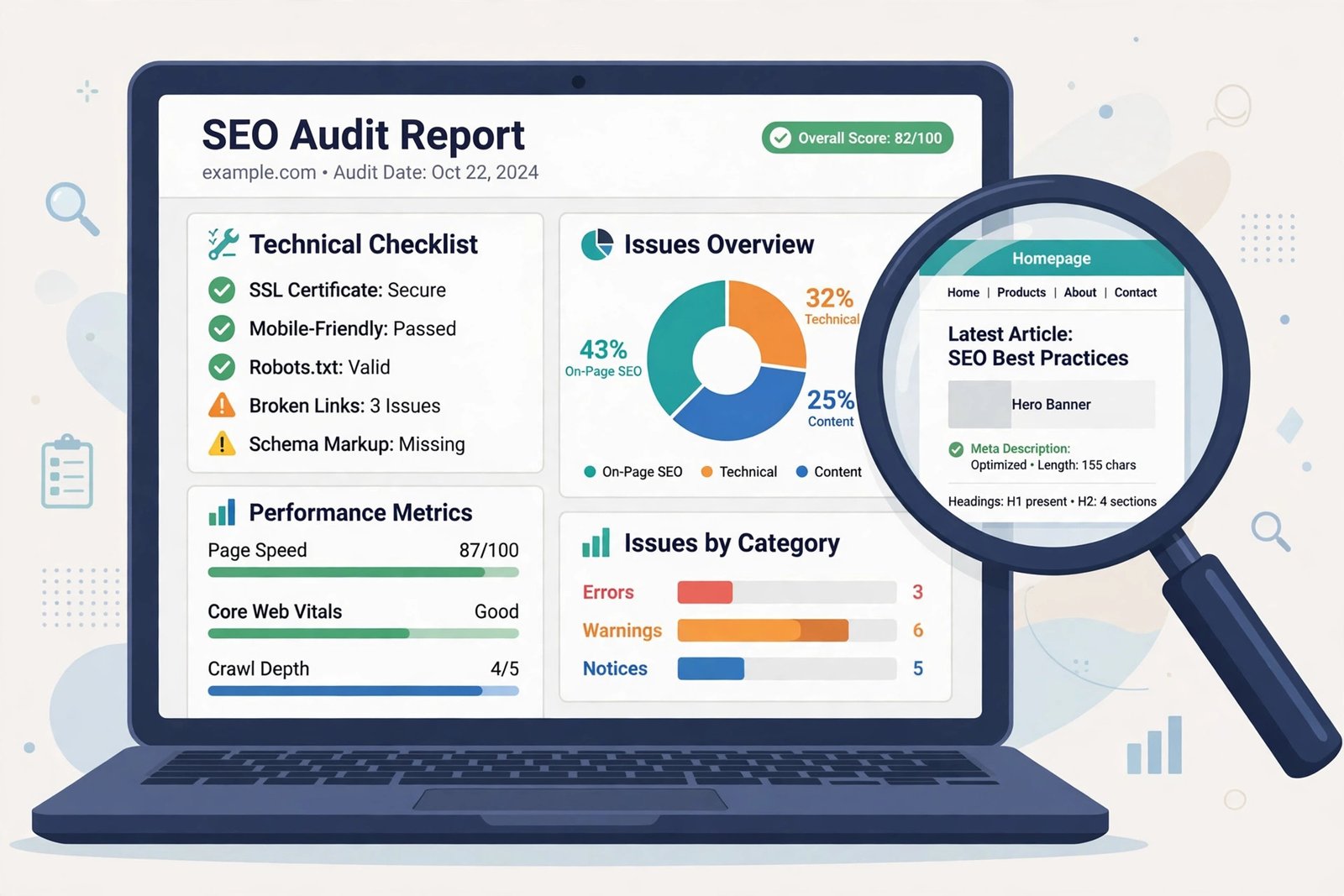
If the findings point to deeper problems — pages that cannot be indexed, a site structure that buries your best content, or a backlink profile that looks unnatural — that is the point where a full review earns its keep, as explained in our guide to SEO audit services. A competitive analysis shows you where you stand against rivals; an audit shows you what is broken underneath your own site. The two work best together.

Common Mistakes to Avoid
- Studying the wrong rivals: Business competitors who do not rank are less relevant than search competitors who do.
- Copying instead of beating: Matching a rival page for page leaves you second. Find the angle they missed.
- Trusting single-tool estimates: Traffic and keyword figures are estimates; compare tools and trust trends.
- Chasing every gap: A hundred keyword gaps with no priority is worse than ten you actually act on.
- Running it once and forgetting: Competitors change. Re-run the comparison quarterly.
Frequently Asked Questions
How often should I run a competitive analysis?
A full analysis once or twice a year, with a lighter check on rankings and traffic every quarter, is enough for most businesses. Fast-moving niches may justify a quarterly full run.
Can I do competitive analysis with free tools?
Yes, for the basics. Free tiers of traffic checkers, keyword tools and backlink checkers cover traffic estimates, shared keywords and top pages. Paid tools add depth and history, but they are not required to find your biggest gaps.
Should I copy my competitor’s keywords?
Target the same topics, but win them your own way: better depth, fresher data, a clearer format, or a stronger angle. Search engines reward the better answer, not the second copy of it.
What if my competitors are much bigger than me?
Do not fight them head-on for their strongest terms. Win the narrower, lower-competition terms they ignore, build authority there, and expand upward over time.
Conclusion
Competitive analysis is not about watching rivals; it is about making better decisions than you would make blind. Find your real search competitors, benchmark their traffic, keywords, content and links, and turn the gaps into a short list of actions you will actually complete. Do that quarterly, and your competitors stop being a mystery — they become the map that shows you exactly where the next win is.