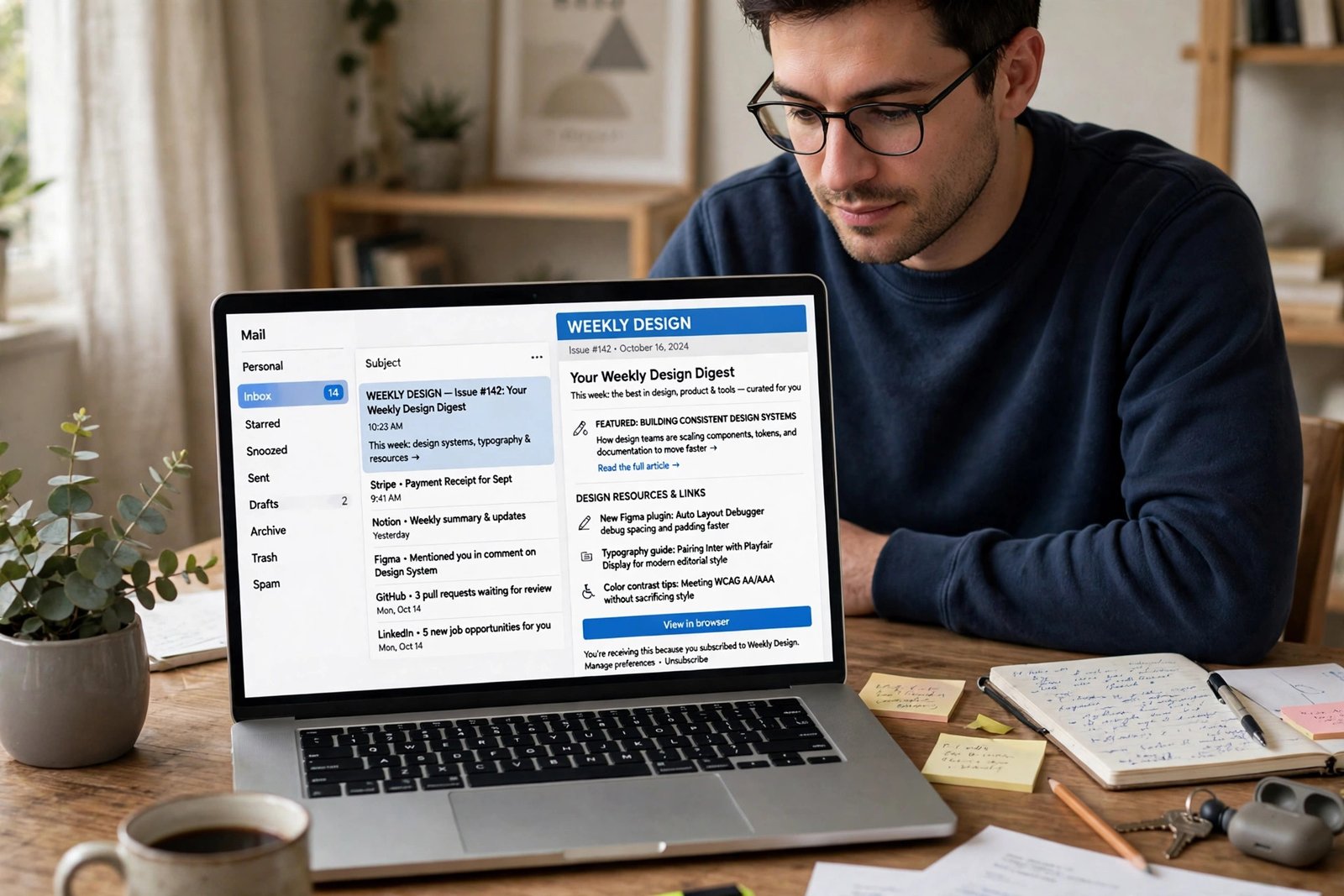
A newsletter by mail is, in plain terms, an email sent on a regular basis to people who have asked to hear from you. The phrase sounds old-fashioned, and that is part of the point. Long before social feeds and short-form video, businesses kept in touch by post, and email took over that job: a direct message, delivered to a person rather than broadcast to an algorithm, arriving in a place they check every day. Despite endless predictions that email would fade away, it has not. For many small and medium businesses in the UK, a newsletter remains the most reliable way to stay in front of customers between purchases, to share useful news, and to bring people back to a website again and again.
This guide explains why email newsletters still work, what makes one that people actually open rather than delete, how to build a mailing list honestly, how to structure each issue, how often to send, and how to measure whether it is working. There are no tricks here, and no inflated promises. A newsletter is a slow, steady marketing channel. Done well, it builds trust over time. Done badly, it trains people to ignore you, or to unsubscribe at the first opportunity.
Why Email Newsletters Still Work
The first reason newsletters endure is ownership. When you build a following on a social platform, you are renting attention. The platform decides who sees your posts, in what order, and under what rules, and those rules change without warning. A mailing list is different. The addresses belong to your relationship with your readers, and you can reach them directly whenever you have something worth saying. Nobody can throttle your newsletter down to a fraction of your audience because an algorithm has moved on.
The second reason is intent. A social follower may have tapped a button in passing and forgotten about you the next day. A newsletter subscriber has taken a deliberate step: they have handed over an email address and asked to hear from you. That is a stronger signal of interest, and it changes the tone of the conversation. You are not interrupting someone mid-scroll. You are writing to someone who invited you in, and that permission is worth protecting.
The third reason is staying power. Social posts vanish within hours. Search traffic depends on rankings that shift. An email sits in an inbox until the reader deals with it, and even a reader who does not open every issue still sees your name, your subject line, and your topic on a regular basis. That quiet, repeated presence keeps a business familiar. When the reader eventually needs what you sell, your name is already known, which is a large part of what marketing is for.
None of this means a newsletter replaces everything else. It works best as part of a wider presence: a website that earns search traffic, social channels that reach new people, and a newsletter that keeps the people who already found you. Each channel does a different job, and the newsletter’s job is retention and return visits. It turns one-off visitors into an audience you can speak to again.
What Makes a Newsletter People Actually Open
People do not open newsletters out of loyalty. They open them because the last few issues were worth opening, and because the subject line promises something specific. The single most important factor is therefore consistency of value. If every issue teaches the reader something useful, answers a real question, or saves them time or effort, opening becomes a habit. If issues are thinly disguised sales pitches, the habit breaks just as fast.
Subject lines matter, but they work best when they are honest and specific. A subject line that names the actual topic of the issue will outperform a vague teaser, because readers decide in a second whether the email is for them. Clickbait subject lines may win one open and lose the reader. The same applies to the sender name. People open mail from a name they recognise, whether that is a person or a business they trust, so keep the sender name steady rather than changing it from issue to issue.
The opening lines matter almost as much as the subject. Many inboxes show a short preview of the email body, and readers use it to judge whether to open fully or move on. Start with the point, not with a long greeting or a company announcement that only matters internally. If the most useful thing in the issue is buried at the bottom, many readers will never reach it. Put the strongest item first, and let the rest follow.
Design supports all of this but does not replace it. A clean layout, readable type, and a layout that works on a phone matter enormously, because a large share of email is read on mobile devices. But no template can rescue weak content. The best-looking newsletter in the world will still be deleted if it says nothing worth reading, while a plain, well-written email from a trusted source will be read to the end.
Building a List Honestly
A mailing list is only as good as the way it was built. The honest route is slower, and that is exactly why it works. People join because they want your emails, so they open them, read them, and stay subscribed. The dishonest routes — buying lists, scraping addresses, or adding people who never asked — produce the opposite: low engagement, complaints, spam reports, and damage to your sender reputation that can affect every email you send afterwards. In the UK, data protection rules also require a proper legal basis for marketing email, and consent is the cleanest basis for a newsletter. When in doubt, the rule is simple: only email people who have clearly asked you to.
The most effective honest method is also the simplest: a clear signup form on your own website, placed where interested visitors will find it — on the homepage, at the end of articles, and on a dedicated signup page. Tell people exactly what they will receive and how often, and keep that promise. A form that says weekly and then sends daily has broken trust before the second issue. A short note about what the newsletter covers does more for signups than a long sales pitch, because it lets the visitor decide whether the newsletter is for them.
Offering something in return can help, provided it is genuinely useful and honestly described. A short guide, a checklist, a template, or a genuinely helpful resource related to your business gives a visitor a reason to sign up now rather than later. What matters is that the free resource is good in its own right, not a thin excuse to collect an address, and that the newsletter that follows is just as good. Otherwise you have traded one download for an immediate unsubscribe.
Existing customers are another honest source of subscribers, with one condition: they must be asked. A checkbox at checkout or on an enquiry form, left unticked by default and worded plainly, lets a customer opt in without pressure. Offline routes work too — a signup sheet at an event, or a card in a shop — as long as the person understands they are joining a mailing list and not merely leaving contact details for a single transaction. However the address is collected, keep a record of how and when consent was given. That record protects both you and the subscriber.
Your website itself is the engine of list growth, which is why the health of the site matters. If search traffic is not reaching your signup pages, or if pages are slow, broken, or hard to navigate, visitors leave before they ever see the form. Understanding where your visitors come from, as explained in our guide to using a website traffic checker, helps you see which pages attract the right people and where a signup form would actually be seen. If a technical review shows deeper problems with the site, the kind of review described in our guide to SEO audit services can identify them, and improving the pages that already perform, as covered in our guide to increasing a website’s page rank, brings more of the right visitors to the pages where they can choose to subscribe.
Content Structure That Works
A reliable structure makes writing each issue easier and reading each issue easier. Readers should be able to recognise the shape of your newsletter within a couple of issues, so they know where to look for what they care about. A structure that works for most business newsletters has a small number of parts, each with a clear job.
Start with one main item. This is the strongest piece of content in the issue: a useful explanation, a practical how-to, an honest opinion, or a story from your work that teaches something. Give it room. A newsletter that tries to cover everything in shallow snippets ends up saying nothing memorable, while one strong item gives the reader a reason to have opened the email at all.
Follow with shorter secondary items. These might be links to recent articles on your site, a brief news item relevant to your readers, a tip of the week, or a short answer to a question customers keep asking. Keep each one brief and link out for the full detail rather than reproducing whole articles inside the email. The newsletter is a guide to your best material, not a replacement for it.
Include one clear call to action, not several competing ones. If the main item is an article, the action is to read it. If you have an offer, the action is to take it up. If you want replies, ask a question and invite readers to answer it. Newsletters that ask the reader to buy, book, download, share, and reply all at once usually achieve none of them, because the reader cannot tell what matters most.
Finish with the practical details readers expect: who the newsletter is from, how to get in touch, and a straightforward way to unsubscribe. An easy unsubscribe link is not a weakness. It keeps your list clean, because people who no longer want your emails leave quietly instead of marking you as spam, and it signals confidence that the people who stay are there by choice.
Frequency: How Often Should You Send?
There is no single correct frequency, and anyone who promises one is guessing about your audience. What matters is that the frequency matches two things: how much genuinely useful material you can produce, and how often your readers want to hear from you. A weekly newsletter suits businesses with a steady flow of news, advice, or content. A monthly newsletter suits businesses where the topic changes more slowly, or where each issue takes real work to produce well. Both can work. Neither works if the schedule is chosen for ambition rather than capacity.
The most common mistake is starting too often. A new newsletter launched with a promise of daily or twice-weekly sends quickly runs out of strong material, and the quality drops issue by issue until readers drift away. It is far better to start monthly, prove you can sustain it, and increase frequency only when you have more good material than fits in one issue. Readers rarely complain that a good newsletter arrives too rarely. They complain, by unsubscribing, when a weak one arrives too often.
Consistency matters more than the exact interval. A newsletter that arrives every Tuesday builds a habit. One that arrives in bursts — several in one month, then silence for months — does not, and each return after a gap has to re-earn attention from readers who may have forgotten who you are. Pick a rhythm you can keep for a year, put it in your calendar, and treat it as a commitment rather than a task to fit in when time allows.
Seasonal variation is fine, provided it is explained. A business may send more often around a busy period and less often in a quiet one. The key is to tell readers what to expect, so a change in rhythm reads as a deliberate choice rather than a lapse. If you need to pause, say so in advance. A short note explaining a break preserves more goodwill than unexplained silence followed by a sudden return.
Measuring Success Without Chasing Vanity Numbers
Measuring a newsletter starts with deciding what it is for. If its job is to bring people back to your website, then website visits from email matter more than any single email metric. If its job is to generate enquiries, then replies and enquiries matter. If its job is to keep customers informed, then steady engagement over time matters. Without a clear purpose, every number looks equally important, and none of them guides a decision.
Open figures deserve a word of caution. They are widely reported, but they are not as precise as they appear, because privacy protections in modern email and devices mean some opens are not recorded and others are recorded without a human ever reading the email. Treat opens as a rough signal of subject-line and sender health, not as a precise measure of readership, and never make a major decision on a small movement in opens alone. Clicks are a firmer signal, because a click is a deliberate action, and the pattern of which links attract clicks tells you what your readers actually care about.
Unsubscribes and complaints are signals too, and they should be read with care rather than feared. A small number of unsubscribes after every issue is normal: it shows your list is cleaning itself of people who no longer want the content. A sudden rise after a particular issue is worth investigating, because it usually points to a mismatch between what was promised and what was sent, a change in tone, or a frequency increase readers did not want. Spam complaints, by contrast, are always a warning. Even a small number should prompt a review of how addresses were collected and whether expectations were set clearly.
The most useful measure is often the least technical: replies. A newsletter that prompts readers to answer a question, share an experience, or ask for help creates a conversation, and the quality of those replies tells you more about whether the content is landing than any dashboard. Track the outcomes that matter to the business as well — enquiries that mention the newsletter, return visits, and repeat purchases from subscribers — and judge the newsletter on those, over months rather than on a single issue. For the website side of that picture, understanding your traffic, as explained in our guide to using a website traffic checker, helps separate visits driven by email from visits driven by search or social channels.

Common Mistakes to Avoid
The first mistake is writing about yourself when the reader wants content about their problems. Company news has a place, but a newsletter that is mostly internal announcements — staff changes, office moves, awards — will lose readers who signed up for useful advice. A good test for every item is to ask what the reader gains from it. If the honest answer is nothing, cut it.
The second mistake is inconsistency of voice. A newsletter written by a person, in a recognisable voice, builds a relationship. One that swings between stiff corporate language and casual slang, or that is clearly written by a different person every issue with no editorial hand, feels anonymous. Readers subscribe to a voice they trust, so keep the tone steady even if more than one person contributes.
The third mistake is neglecting the basics: broken links, images that do not load, a layout that falls apart on a phone, or a send to a list that has not been cleaned. Test every issue before sending it, on a phone as well as a desktop, and check every link. A single broken main link wastes the whole issue, because the reader who clicks and finds nothing has no reason to try again next time.
The fourth mistake is treating the list as a number to grow at any cost. A list of people who never open your emails is not an asset. It costs money to send to, it drags down engagement, and it increases the risk of spam complaints. Regularly removing addresses that never engage, after giving them a chance to stay with a re-engagement message, leaves a smaller, healthier list that actually reads what you send. Quality beats size, every time.
Frequently Asked Questions
Is a newsletter by mail the same as email marketing?
Broadly, yes, but with a useful distinction. Email marketing covers all promotional email, including one-off offers and automated messages. A newsletter is a regular, editorial publication sent to subscribers: a mix of useful content, news, and occasional offers, with its own rhythm and identity.
Do I need special software to send a newsletter?
You need a proper email sending tool rather than your ordinary inbox, because ordinary email is not built for bulk sending, subscription management, or unsubscribes. Most tools handle signup forms, list management, templates, and basic reporting, so choose one that fits the size of your list and your comfort with technology.
How long should a newsletter be?
As long as it needs to be to deliver its main item well, and no longer. Some newsletters are a single useful insight. Others are a longer read with several sections. Length is less important than whether every part earns its place, and whether a busy reader can grasp the value within the first few lines.
Should every newsletter try to sell something?
No. A newsletter that sells in every issue trains readers to expect a pitch and to skip it. Useful content builds the trust that makes an occasional offer welcome. When you do include an offer, make it relevant to the content around it, and make it the single clear action for that issue.
Conclusion
A newsletter by mail succeeds for unglamorous reasons: it reaches people directly, it is built on permission, and it rewards consistency. Start with a clear promise about what readers will receive and how often, build the list honestly from your own website and customers, structure each issue around one strong item with a single clear action, and measure success by clicks, replies, and real business outcomes rather than by vanity numbers. Do that steadily for months, and the newsletter becomes something no algorithm can take away: an audience that chose you, and keeps choosing to open your mail.